
Reflections: When Jesus Meets the Buddha
A review of Separation of Church and Hate by John Fugelsang, with some thoughts on the value of engaging with different religions and spiritual practices (and atheism, too).


John Fugelsang’s book, Separation of Church and Hate: A Sane Person’s Guide to Taking Back the Bible from Fundamentalists, Fascists, and Flock-Fleecing Frauds, caught my attention primarily because of its position as a corrective to the abuses of Christian thinking perpetrated by various people in positions of power. Although using religious teachings in political, self-serving and harmful ways is nothing new, and certainly not unique to Christianity, it’s nevertheless a timely book given how we are in the midst of a global spiritual crisis. Of course, we could say that humanity has always been in a state of spiritual crisis – it’s called the human condition! And I’d agree. What’s different is how globalized it is and how technology is having an impact given its ability to disseminate disinformation and manipulate emotions – to confuse minds, essentially. And this is where the book surprised me, because while Fugelsang is primarily focused on pushing back on toxic tendencies in Christianity, his book points to broader lessons that every religion/spiritual practice can benefit from. Before sharing some thoughts about that, here’s my review of the book as posted to Goodreads.
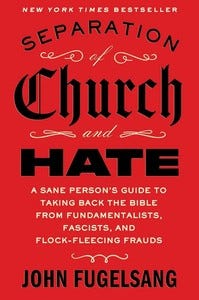
A Review of Separation of Church and Hate
One of the defining challenges of the human condition is the perpetual struggle to reconcile doing what we want and doing what is morally right. While we could point to the rational problem of defining what is “morally right,” it’s really a matter of psychology: survival instincts filtered through experiences of pleasure and pain before the conscious aspect of the mind can intervene. Despite what the Enlightenment thinkers believed, we are not “rational” in the sense that we can automatically rely on our decision-making as being logical, evidence-based, unbiased, and rooted in an accurate perception of the world around. We are emotional. Which isn’t to say that we can’t be rational, tailoring our thinking and actions to conceptual reasoning rather than to raw desires. Rather, it’s that rationality is a skill to be cultivated, requiring a certain degree of self-awareness, intentionality, and humility. And it’s because rationality is a mental skill that we run into problems, because it’s easier to just give in to our desires than to rein them in because of “concept.” And it’s easier to rationalize desires – justify them after the fact – than to pause and consider before acting. Especially if by rationalizing we can avoid feeling guilty, ashamed, wrong over actions – feeling bad about ourselves, in other words – that are in conflict with moral standards.
Hence, religious hypocrisy.
This isn’t just the hypocrisy of pastors who preach from the Bible while engaging in sexual misconduct or embezzling church funds, but the fundamental problem of people who claim to be part of a religion yet don’t actually put the teachings of their religion into practice. One notable and underreported example is the persecution (genocide) of the Rohingya people in Myanmar/Burma – currently subject to hearings at the International Court of Justice – with the support and encouragement of Buddhist spiritual authorities. Despite there not being any justifications for violence or oppression of any kind in the Buddha’s teaching, somehow these “authorities” have created a horrific loophole for themselves by essentially declaring that the lives of non-Buddhists, being like animals in ignorance of distinctions between good and evil, are unworthy of sanctity on par with the lives of Buddhists. (See BuddhistDoor) This is unequivocally wrong, and an example of how any religion can be tailored to suit one’s selfish desires (rationalized) as opposed to shaping those selfish desires according to spiritual teachings.
John Fugelsang’s book, Separation of Church and Hate, isn’t about Buddhism, of course. It takes aim instead at the religious hypocrisy of people who call themselves “Christian” yet don’t actually put Jesus’ teachings into practice. Instead, they justify their prejudices, bigotry, judgements, and harmful actions by pointing to every part of the Bible except for the ones in which Jesus shares his teachings: the Gospels. Much like the Protagonist in Christopher Nolan’s TENET, Fugelsang makes his argument from two opposing directions: what Jesus taught and what Jesus didn’t teach.
What didn’t Jesus teach? Condemning women, LGBTQ+ people, and strangers. He didn’t advocate for war and violence, nor did he advocate the pursuit of material wealth as a moral good or express an opinion about contraception and abortion.
And what did he actually teach? Compassion and generosity to the poor/sick/disadvantaged, hospitality to the stranger and the outcast, a rejection of violence, not judging others, forgiveness. If you want to put in a word: love. Not hate. Not anger. Not judgment. Love. Mr. Matthew, bring it:
Matthew 22:34-40 (NRSVA): 34 When the Pharisees heard that he had silenced the Sadducees, they gathered together, 35 and one of them, a lawyer, asked him a question to test him. 36 ‘Teacher, which commandment in the law is the greatest?’ 37 He said to him, ‘“You shall love the Lord your God with all your heart, and with all your soul, and with all your mind.” 38 This is the greatest and first commandment. 39 And a second is like it: “You shall love your neighbour as yourself.” 40 On these two commandments hang all the law and the prophets.’
Fugelsang not only makes his argument with clarity and support from Biblical citations, but with a sense of humor too. He’s a funny guy, which makes the book fun and easy to read. But more importantly, he writes with kindness that is firm in rejecting hateful distortions of Christianity but warm in casting a wide net to invite people to think more deeply about Jesus’ teachings. We could say that, without pretensions, Fugelsang makes Jesus Jesus again.
Some people might object arguments on the grounds that, in their view, the entire Bible is the inspired and perfect word of God. But this ignores how the Bible is filled with contradictions and, specifically, that its parts were never conceived to form a whole. What does it say about the Bible as a holistic scripture when it has been used to support opposing sides of issues like slavery? Although Fugelsang doesn’t get into the history of how the Bible was written, there’s a clear sense that he’s aware of the scholarship on the issue and the understanding that books in the Bible were written by different peoples with different cultures at different times for different purposes. Reading books like Tim Callahan’s Secret Origins of the Bible or Randell McCraw Helms’ The Bible Against Itself: Why the Bible Seems to Contradict Itself, we can understand the circumstances – from the perspective of archaeology, anthropology, history, comparative mythology – that guided how the Bible’s books were written and how religious thinking within the Judeo-Christian tradition evolved over centuries. By acknowledging the reality of what the Bible is, Fugelsang is on solid ground when he points to a particular belief and says, that’s Jesus or that’s Paul (who never met Jesus, btw) or that’s from people before Jesus’ time.
Understanding the Bible as a collection of parts rather than a singular whole isn’t a bad thing for a simple reason: it relieves the obligation to have to reconcile impossible contradictions. If a Christian identifies as a Christian, then it’s the Jesus of the Gospels that should take precedence. This doesn’t mean that the Old Testament and Paul’s writings can’t offer insights, comfort, or even guidance. But it does mean that when there’s a Scriptural conflict, Jesus gets the first and last word. Isn’t that the definition of “Christian” – centering spiritual practices around Jesus’ teachings?
Broadly speaking, the book is a reminder about the importance of actually reading a text. Maybe the nuances require some explanation from teachers, scholars and experienced practioners, but at the very least we should know what the text actually says so we aren’t led astray by inaccurate, if not outright misleading, “explanations.” For Christians, Fugelsang’s book works as a reminder to refocus attention on the heart of Christian belief, a pep talk that offers moral support amidst toxic cultural conversations about religion, and a guide for pushing back against distorted teachings causing harm to our communities. Despite its serious title, it’s very hopeful and positive book.
What may be surprising is that the book holds appeal and value for non-Christians as well, whether of different religions or atheists. “Some of the best humans I’ve known have been Christ followers, and they weren’t all Christian,” Fugelsang writes. Much like Pope Leo XIV recently told the AP on a visit to the Great Mosque in Algiers, “although we have different beliefs, we have different ways of worshipping, we have different ways of living, we can live together in peace,” he emphasizes the importance of doing good versus getting divided over metaphysical debates and filling church pews. He makes it possible for everyone to find inspiration in Jesus’ teachings, in their own way, and ultimately find common ground in doing what is most important: take care of each other. And that is a wonderful accomplishment for a humble book.
Many Doorways, One House
Tricyle Magazine recently published an excerpt from Stephen Batchelor’s book, Buddha, Socrates, and Us: Ethical Living in Uncertain Times, in which he points to commonalities between ancient Greek (and Roman) philosophy and Buddhist teachings. It’s a commonality I’ve noted myself, particularly in reading Epicurus and, incompletely, Marcus Aurelius, and points to a counterpart to Fugelsang’s observation that “Some of the best humans I’ve known have been Christ followers, and they weren’t all Christian.” And that counterpart is this: we can find the Dhamma even in people who don’t specifically follow the Buddha’s teachings.
There’s a wonderful universality among spiritual traditions as to what constitutes the moral good – a collective moral intuition, despite differences in details and approaches. If we were talking about facts, such as whether the Earth is flat or round, I’d point out how the popularity of a belief is no indicator of its truth. But we’re talking about truths that are defined both objectively AND subjectively, as a combination of a correct understanding of reality and consensus over how we should best live our lives. Don’t worry, I’m not going to sidebar into an obtuse discussion of epistemology. I just want to make the point that our moral intuitions have a pragmatic aspect to them. A peaceful, harmonious society can’t be a peaceful, harmonious society if people routinely murder, steal, lie, and generally hurt each other. So if you want that peaceful, harmonious society, it makes sense to minimize the amount of murdering, stealing, lying, and other forms of hurting that goes on.
One of most dangerous deceits of spiritual practice is the belief that one’s way is the one, true, correct, and only way. While this might be true by definition in particular ways – for example, if we believe in heaven than we have to have a faith in the conditions that allow us to obtain salvation or if we want to put an end to our suffering than we must nurture conviction in the path to achieve liberation – this doesn’t mean that this true in totality.
With point given for inspiring me to re-read the Gospels, what Fugelsang explains about Jesus’ teachings resonates with the Buddha’s teaching because, when we set aside metaphysical debates on the nature of the universe and whatever divine aspects it may or may not have, the guidance from each tradition for how to live in the world points in the same direction. Whether its Father Greg Boyle and his efforts via Homeboy Industries to rehabilitate former gang members or Ven. Bikkhu Bodhi’s efforts to alleviate chronic hunger and malnutrition via Buddhist Global Relief, we should celebrate how we do agree on what needs to be done even if the philosophical, i.e. religious, rationale differs. That’s the blueprint for co-existence despite ideological differences that hold tremendous personal significance. Many doorways, one house.
Something else to consider about the universality of moral intuitions is how it offers the possibility to learn from other traditions to gain insights into our own. While I agree with Ven. Thanissaro Bikkhu about the risks of syncretism in practice – picking and choosing from various traditions, like choosing different foods from a buffet, that compromises the benefits that come from following them holistically – I think there are benefits to engaging with other traditions. When Jesus says to love your neighbor as yourself, how does that relate to the Buddhist concept of interconnectedness and “not self?” It’s like approaching a problem from different angles to get a better understanding of it. And it’s very much in line with what might call the Buddha’s pedagogy: the tailored his teachings of the Dhamma to his audience. He met them where they were at in their journey so they could learn what they needed to learn at that moment in time so they can move forward in their practice. This doesn’t mean having a kludge for a spiritual practice, some awkwardly cobbled-together spiritual-ish thing that confuses more than clarifies. It just means that looking at our practice through another lens can lead to deeper and richer insights. And this applies as much to interactions between religious people and atheists, who wield important critiques to consider.
Altogether, it’s a way for all of us to support each other on our spiritual paths to achieve the shared goal of a loving, peaceful world while respecting each other’s individual needs and personal freedoms.
A Vital Lesson for Practice
In my review, I purposely started with a mention of the horrors experienced by the Rohingya people in Myanmar because I think it’s important to acknowledge how universal the challenges of spiritual practice are. There’s a tendency to equate virtue with believing in the right, correct ideas, and there’s some merit to that insofar that we can’t act “correctly” if we don’t have good ideas of what it means to act “correctly.” But that’s only one aspect of virtue. The other is how we put those ideas into practice. Even the best ideas don’t mean anything if we don’t act accordingly. And why does that happen? That gap between ideation and action can come in different forms, from misunderstanding or otherwise distorting those ideas, lack of community support, and/or lack of spiritual discipline and commitment.
The implication of Fugelsang’s book is that it’s crucial to read foundational texts and understand, as best as possible, the circumstances in which they were written. Given the balance we strive to achieve between learning from authoritative teachers and avoiding the trap of blind obedience (and cults of personality), it’s vital to have direct exposure to whatever scriptures/texts define the spiritual traditions we follow. Because that’s how we keep our teachers honest and accountable in their guidance just as they should keep us honest and accountable in our own practice. This is why I’m specifically drawn to Buddhism’s Theravadan tradition; it’s rooted in the Pali Canon and its presentation of the Buddha’s teachings, and thus offers a baseline for engaging with what I learn from teachers. This isn’t to say that later texts from other Buddhist traditions and writers can’t or don’t hold any insights – many do – but that these later scriptures are other people’s interpretations of the Buddha’s teachings and they differ in terms of how well they align. It’s comparable to reading Paul’s writings in the Bible versus reading Jesus’ teachings directly from the Gospels.
While Fugelsang is focused specifically on rebutting distortions of Jesus’ teachings, his book supports deeper thinking on what it means to be a Christian, which offers insights into what it means to practice within any religious, spiritual or secular moral tradition. Give it a read, and see what comes up for you …